A Request to the Supreme Court That It Review a Case That Was Already Decided Is Made via a(N)
Commodity III of the Constitution of the United States guarantees that every person accused of wrongdoing has the right to a fair trial before a competent judge and a jury of one'due south peers.
Where the Executive and Legislative branches are elected by the people, members of the Judicial Branch are appointed past the President and confirmed by the Senate.
Article Iii of the Constitution, which establishes the Judicial Branch, leaves Congress significant discretion to determine the shape and construction of the federal judiciary. Even the number of Supreme Courtroom Justices is left to Congress — at times in that location have been equally few as six, while the current number (nine, with one Primary Justice and eight Associate Justices) has only been in place since 1869. The Constitution also grants Congress the power to establish courts inferior to the Supreme Court, and to that end Congress has established the Us district courts, which endeavor most federal cases, and thirteen United States courts of appeals, which review appealed district court cases.
Federal judges tin can but be removed through impeachment by the Firm of Representatives and confidence in the Senate. Judges and justices serve no fixed term — they serve until their decease, retirement, or conviction by the Senate. By pattern, this insulates them from the temporary passions of the public, and allows them to use the law with only justice in mind, and not electoral or political concerns.
By and large, Congress determines the jurisdiction of the federal courts. In some cases, however — such as in the instance of a dispute between two or more U.S. states — the Constitution grants the Supreme Court original jurisdiction, an authority that cannot be stripped by Congress.
The courts simply endeavour bodily cases and controversies — a political party must evidence that it has been harmed in social club to bring suit in court. This ways that the courts exercise not issue informational opinions on the constitutionality of laws or the legality of actions if the ruling would take no applied effect. Cases brought before the judiciary typically proceed from district courtroom to appellate court and may even end at the Supreme Court, although the Supreme Courtroom hears comparatively few cases each year.
Federal courts enjoy the sole power to interpret the police, determine the constitutionality of the law, and use it to private cases. The courts, like Congress, can compel the production of bear witness and testimony through the apply of a subpoena. The inferior courts are constrained by the decisions of the Supreme Courtroom — one time the Supreme Court interprets a constabulary, junior courts must utilize the Supreme Court'south interpretation to the facts of a particular instance.
The Supreme Court of the U.s.a. | The Judicial Procedure
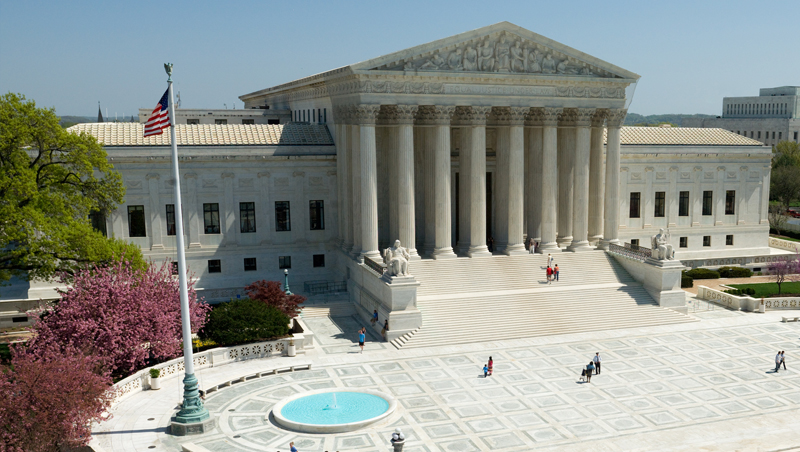
The Supreme Court of the United States
The Supreme Court of the United states of america is the highest courtroom in the land and the only part of the federal judiciary specifically required by the Constitution.
The Constitution does not stipulate the number of Supreme Court Justices; the number is set instead by Congress. At that place have been as few every bit half-dozen, but since 1869 there have been nine Justices, including 1 Main Justice. All Justices are nominated past the President, confirmed by the Senate, and concur their offices under life tenure. Since Justices do not have to run or campaign for re-ballot, they are thought to exist insulated from political pressure when deciding cases. Justices may remain in role until they resign, pass away, or are impeached and bedevilled by Congress.
The Court'due south caseload is almost entirely appellate in nature, and the Court'southward decisions cannot be appealed to whatsoever authority, as it is the concluding judicial czar in the United States on matters of federal law. However, the Court may consider appeals from the highest state courts or from federal appellate courts. The Court also has original jurisdiction in cases involving ambassadors and other diplomats, and in cases between states.
Although the Supreme Court may hear an appeal on any question of law provided it has jurisdiction, it normally does non hold trials. Instead, the Court'southward task is to translate the significant of a police force, to decide whether a police is relevant to a item fix of facts, or to rule on how a law should exist applied. Lower courts are obligated to follow the precedent set past the Supreme Court when rendering decisions.
In nigh all instances, the Supreme Court does not hear appeals as a matter of correct; instead, parties must petition the Court for a writ of certiorari. It is the Court'southward custom and practice to "grant cert" if four of the nine Justices determine that they should hear the case. Of the approximately 7,500 requests for certiorari filed each year, the Court unremarkably grants cert to fewer than 150. These are typically cases that the Court considers sufficiently important to require their review; a mutual example is the occasion when two or more of the federal courts of appeals take ruled differently on the same question of federal police force.
If the Court grants certiorari, Justices accept legal briefs from the parties to the instance, as well as from amicus curiae, or "friends of the court." These tin include industry trade groups, academics, or fifty-fifty the U.S. government itself. Before issuing a ruling, the Supreme Court normally hears oral arguments, where the various parties to the suit present their arguments and the Justices inquire them questions. If the case involves the federal government, the Solicitor General of the United States presents arguments on behalf of the United States. The Justices then hold private conferences, make their conclusion, and (oft after a menstruum of several months) issue the Court's opinion, along with whatever dissenting arguments that may have been written.
The Judicial Process
Article III of the Constitution of the The states guarantees that every person accused of wrongdoing has the right to a fair trial earlier a competent gauge and a jury of 1's peers.
The Fourth, Fifth, and 6th Amendments to the Constitution provide additional protections for those accused of a offense. These include:
- A guarantee that no person shall be deprived of life, liberty, or belongings without the due process of law
- Protection against being tried for the same crime twice ("double jeopardy")
- The right to a speedy trial by an impartial jury
- The right to catechize witnesses, and to call witnesses to support their case
- The correct to legal representation
- The right to avoid self-incrimination
- Protection from excessive bail, excessive fines, and roughshod and unusual punishments
Criminal proceedings can be conducted nether either land or federal law, depending on the nature and extent of the law-breaking. A criminal legal procedure typically begins with an arrest by a law enforcement officer. If a grand jury chooses to deliver an indictment, the defendant volition appear before a judge and exist formally charged with a criminal offence, at which time he or she may enter a plea.
The defendant is given fourth dimension to review all the show in the case and to build a legal argument. Then, the example is brought to trial and decided by a jury. If the defendant is adamant to be not guilty of the offense, the charges are dismissed. Otherwise, the gauge determines the sentence, which can include prison time, a fine, or even execution.
Civil cases are similar to criminal ones, but instead of arbitrating between the state and a person or organization, they deal with disputes betwixt individuals or organizations. If a party believes that information technology has been wronged, information technology can file suit in civil court to attempt to accept that wrong remedied through an guild to cease and desist, alter behavior, or laurels monetary damages. After the suit is filed and evidence is gathered and presented by both sides, a trial proceeds equally in a criminal instance. If the parties involved waive their right to a jury trial, the case can be decided past a judge; otherwise, the instance is decided and damages awarded by a jury.
After a criminal or civil instance is tried, it may exist appealed to a higher court — a federal court of appeals or state appellate court. A litigant who files an entreatment, known as an "appellant," must testify that the trial court or administrative agency fabricated a legal error that affected the outcome of the case. An appellate court makes its conclusion based on the record of the case established by the trial court or agency — information technology does not receive additional evidence or hear witnesses. It may also review the factual findings of the trial court or agency, merely typically may only overturn a trial outcome on factual grounds if the findings were "clearly erroneous." If a defendant is found non guilty in a criminal proceeding, he or she cannot exist retried on the same set up of facts.
Federal appeals are decided by panels of three judges. The appellant presents legal arguments to the panel, in a written certificate called a "brief." In the brief, the appellant tries to persuade the judges that the trial courtroom made an error, and that the lower decision should be reversed. On the other manus, the party defending confronting the appeal, known as the "appellee" or "respondent," tries in its brief to show why the trial court decision was correct, or why whatsoever errors made by the trial court are not significant enough to affect the event of the case.
The court of appeals usually has the concluding word in the case, unless information technology sends the case back to the trial courtroom for additional proceedings. In some cases the decision may be reviewed en banc — that is, by a larger group of judges of the court of appeals for the circuit.
A litigant who loses in a federal court of appeals, or in the highest court of a country, may file a petition for a "writ of certiorari," which is a document request the Supreme Courtroom to review the case. The Supreme Court, however, is non obligated to grant review. The Court typically will concord to hear a case only when it involves a new and important legal principle, or when two or more than federal appellate courts take interpreted a law differently. (There are besides special circumstances in which the Supreme Court is required past law to hear an entreatment.) When the Supreme Court hears a case, the parties are required to file written briefs and the Court may hear oral argument.
Source: https://obamawhitehouse.archives.gov/1600/judicial-branch
0 Response to "A Request to the Supreme Court That It Review a Case That Was Already Decided Is Made via a(N)"
Post a Comment