An Appropriate Form of Primary Grade Childrens Exploration of Art Media Is
Explore how educators can create accurate, and engaging writing experiences with children, while embedding of import learning foci for development of emergent literacy.
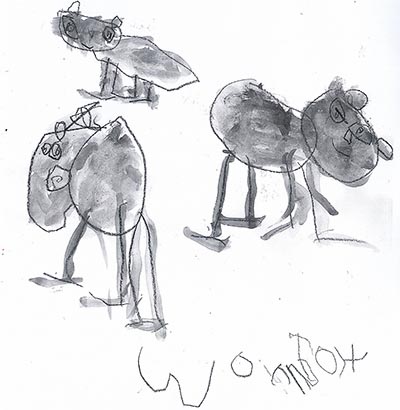
Introduction
Information technology is of import to emphasise that writing with children involves primarily the facilitation of their written expression through the developmental progression from mark marking, scribbling, and cartoon (see Mackenzie, 2011, 2014).
Thus, "writing" refers to all forms of visual and written communication, rather than simply conventional writing which tends to emerge towards the commencement of formal schooling.
We as well explore how elements of print, text, and written language features tin exist introduced during engaging emergent writing experiences.
Writing with children provides opportunities to engage children in meaning making using multiple modes of advice. For case: visual, auditory, tactile, verbal, and written.
The benefits of writing with children for emergent literacy development
Children'southward experiences with writing and creating texts is an important avenue for self-expression in early childhood. These experiences as well back up precursors to their afterward reading and writing development (Saracho, 2017; Puranik & Lonigan, 2011).
Equally children are scaffolded past educators to participate in more varied experiences with writing, their ability to create complex, multimodal texts develops:
Young children begin to explore written advice by scribbling, drawing and producing approximations of writing. They use digital technologies and multimedia resources to communicate, play and acquire. They create and display their ain data in a way that suits different audiences and purposes.- VEYLDF (2016)
Writing experiences provide endless opportunities for developing children'south artistic, also as written expression.
Pedagogies for writing with children
During writing experiences, the function of the educator is to share in the enjoyment and fulfilment of creating texts, besides every bit scaffold children's engagement to develop their emergent literacy skills.
Fellowes and Oakley (2014) emphasise the importance of demonstration (modelling) and practice for emergent writing development, arguing that children need to observe and experiment with the processes used past a competent author.
Children demand continuous experience in writing. They demand the adventure to experiment using what they know nigh writing and the opportunity to use and exercise their developing skills and cognition. The opportunities to write should be available during gratuitous play. - Fellowes and Oakley (2014, p. 358)
While writing together, children and adults engage in different writing behaviours. The following behaviours are grounded in the gradual release of responsibility model (Duke & Pearson, 2002; Fisher & Frey, 2013; Pearson & Gallagher, 1983) which sees the office of educator as initially leading writing experiences (modelled writing), and gradually decreasing responsibility equally children start to share (shared/interacting writing), and eventually create texts with very petty back up (independent writing).
Modelled writing behaviours
- educators compose a text, demonstrating how to create texts using multiple modes (eastward.thou. print, images, and audio - for ICT texts)
- children observe educators during modelled writing
- educators use ''call back-alouds'' to narrate the strategies they are using (e.g. scribbling, drawing shapes, drawing illustrations, annotating, letter formation, writing left to correct)
- depending on the age and emergent writing stage of children, educators will think aloud about unlike writing strategies, somewhere on the continuum of: mark making, scribbling, shape formation, to more than elaborated cartoon, and the addition of print elements.
Past thinking aloud the educator makes it obvious what the practices are for generating ideas and organising sentences and words in a text. Thinking aloud allows the educator to demonstrate more effectively how the author should use skills, knowledge, processes and strategies when writing.
Fellowes & Oakley (2014, p. 449)
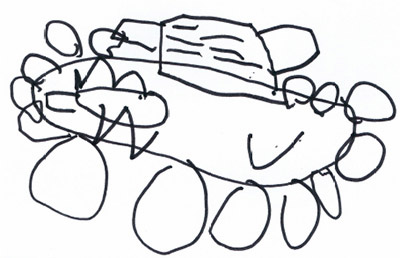
Shared/interactive writing behaviours
- educators provide opportunities for children to create texts together
- educators provide prompts to scaffold children'southward written expression
- children express themselves using written and visual modes, likewise as verbal (and educators annotate or add to children's texts based on their shared ideas)
- through modelling and scaffolding, children learn more than about how texts work, and the features of dissimilar text types:
Over time and with plenty of opportunities to hear and talk about narrative texts and with a developing understanding of the detail in narratives as well as writing skill and fluency, children's stories will progressively display a greater application of the text organisational and linguistic communication features.
- Fellowes and Oakley (2014, p. 383)
Through these shared writing activities children develop a sense of ownership of the text.
Independent writing behaviours
- educators provide infinite, materials, and writing inspiration/stimulus
- children create their own texts from beginning to end, cartoon upon skills and knowledge gained in other emergent literacy experiences
- educators ask children nigh their drawings/writings, and add whatsoever annotations if the child directs them to
- educators may provide support or scaffolding every bit needs ascend, but children are almost entirely independent.
In early childhood settings, it is important to recall of the writing pedagogies in a higher place as fluid and dynamic, rather than as fixed or separate. In these experiences, educators can model and scaffold at unlike levels of support according to the needs of the kid.
This allows educators to create learning experiences that are responsive, intentional, and catering to the learning needs of individual children (i.e. kid-centred) (VEYLDF, 2016).
- Therefore, educators tin can piece of work to encourage modelled/ shared/ independent writing behaviours, depending on factors similar the child's previous writing experiences, their familiarity with the materials, and the text structure process.
Facilitating multimodal written expression
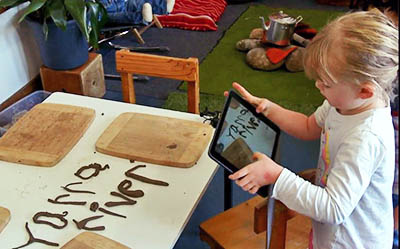
In early childhood settings, significant inside texts is often conveyed in multiple modes (written language, spoken language, visual, audio, gestural, and tactile and spatial systems of meaning) (Kalantzis, Cope, Chan, and Dalley-Trim, 2016).
Examples of multimodal texts include picture books, drawings with annotations, posters, films, web pages, and art works.
Children's written expression begins with combinations of multimodal advice systems, including speech, drawing, music, and dance:
As pocket-size children, we lived in a multimodal world. We discovered that fine art was a language with as much advice power equally speech. Later we learned, like oral language, that the arts could act every bit a bridge to reading and writing and that music and motility had the same potential for contributing to our expression of meaning and self.
- Crafton, Silvers & Brennan (2017, p. 68)
Based on inquiry by Mackenzie (2011, 2014), Puranik and Lonigan (2011), and Sunday (2017), the post-obit pedagogical methods for facilitating children's emergent written expression are explored beneath:
- facilitating cartoon as writing
- incorporating text structures and features
- incorporating elements of print.
These involve facilitating experiences that draw upon fine arts drawing, painting, sculpture, or multimedia text creation, too as facilitating children's experimentation with elements of print in their piece of work.
Facilitating drawing as writing
In Mackenzie and Veresov's (2013) exploration of children's multimodal text cosmos, they highlight Vygotsky's (1997) stardom betwixt sign cosmos (i.e. making up one'south own signs: drawing), and sign use (i.e. using the signs already available in established systems: print/writing).
Mackenzie et al.'s work in this area have shown that encouraging children'southward purposeful use of cartoon as a sophisticated grade of written advice, which helps to facilitate the eventual emergence of conventional writing, at the starting time of Primary school:
The uncomplicated sign employ (written language) is complemented by complex sign creation (drawing) to create multimodal texts in each instance. The children are able to express themselves using ii modes of linguistic communication working together.
- Mackenzie and Veresov (2013, p. 26)
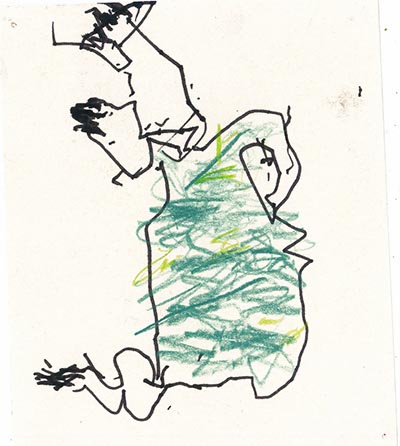
Some other do good of encouraging drawing as emergent writing is that it tin act every bit an anchor for children's ideas as they begin to experiment with letters and engage in experiences (Mackenzie, 2011).
Therefore, valuing drawing and making time and infinite for children to appoint in meaningful drawing experiences can facilitate emergent written expression (Mackenzie, 2011).
This means providing tools for children to express themselves via cartoon, and valuing children's mark making, scribbling, and drawing as communicating a message. Shared and interactive writing experiences let children to observe educators' modelled writing behaviours, and collaboratively contribute to the creation of early on texts.
Come across Making meaning and expressing ideas in texts.
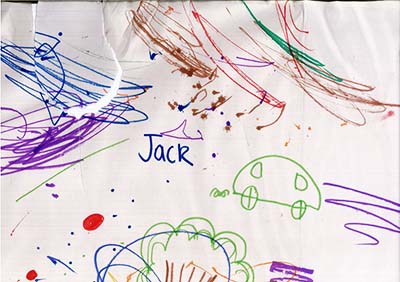
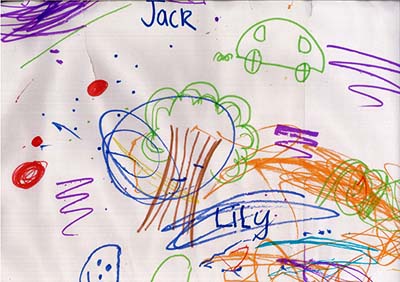
When children are provided materials, time, and scaffolding, they tin can express themselves using complex multimodal texts.
Educators can work with children to scaffold and add to their drawings/writings. Depending on the learning intention, educators can engage in shared/interactive writing behaviours.
Educators tin can also annotate children'southward drawings/paintings to record the child'due south oral narration of their work.
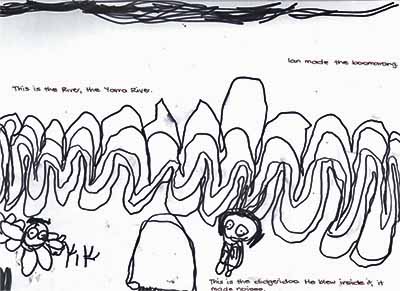
In this way, educators apply the notation process to scaffold children's learning and motivated by the child's want to add other modes of communication (for example: writing) to their texts.
When children want it, educators can work with them to add further meaning to their drawings, such every bit through annotation of children'south oral narrations. Such drawing/writing experiences are closely connected to fine arts experiences incorporating emergent literacy concepts.
- See Fine arts emergent literacy
Introducing text structures and features
As children engage in emergent literacy experiences, they begin to learn near the unique features of written language and multimodal texts.
Fellowes and Oakley (2014, p. 387) recommend the following fundamental understandings relevant to embed within writing experiences with children. Children are developing the post-obit:
- understanding that written texts should be meaningful and communicate information, and that the meaning of a text stays the same each time the text is read
- understanding that the content of a written text comes from the thoughts and ideas of the writer
- knowing that there are unlike purposes and different types of texts for writing and that an author writes for an audience
- the purpose and nature of some familiar types of text, eastward.yard. letter, list, phone message, stories and greeting cards
- impress and text concepts such as writing from left to right and from meridian to bottom on the folio, spaces betwixt words, and the concepts of a discussion, sentence and punctuation mark.
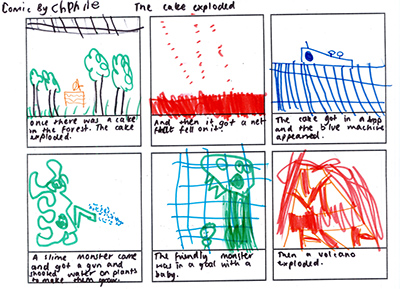
Through emergent reading and writing experiences, children learn about how texts work, and the main differences between text types (genres).
The master text types relevant for early childhood include (adapted from Fellowes & Oakley, 2014):
- personal (expressive) texts, including letters, diaries, journals, and notes
- imaginative (narratives) texts, including stories, fairytales, poems, and play scripts
- informative (expository) texts, including reports, explanations, procedures, and persuasive writing.
For an in-depth exploration of text types (including ICT texts) come across the learning focus Exploring and creating texts.
Fellowes and Oakley (2014) fence that the texts children create "should be for purposes relevant to their lives and interests" (p. 377).
The kinds of texts that can be created during writing experiences with children:
- writing the procedure for the biscuits that are made during a course cooking experience
- preparing for an excursion by writing a reminder list of the things to exist taken
- writing a thank you letter to a recent visiting speaker
- talking and and then writing almost favourite places at home and assembling them together to make a volume for the classroom reading corner
- writing labels for the material containers and special areas of the classroom and then as to assist people to hands locate them
- writing a sign to go over the fish tank advising people most required behaviour when dealing with the fish. - Fellowes and Oakley (2014, p. 377)
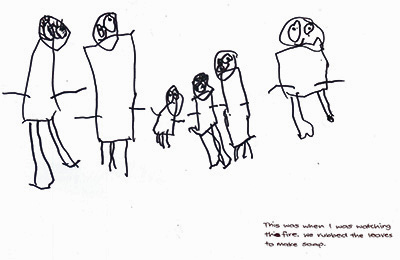
These texts can be created through modelled, shared/interactive, or contained writing experiences.
What is key, however, is that educators embed emergent literacy learning foci within these writing experiences.
Incorporating elements of impress
Equally explored above, children'southward written expression develops on a continuum starting with early mark making, and scribbling:
Young children would benefit from being encouraged to scribble and pretend write during play time … - Puranik and Lonigan (2011, p. 585)
Through writing experiences, including modelling and scaffolding from educators, children brainstorm to also produce drawings that include letter-like characters. Educators tin can engage in modelled and shared writing behaviours to provide multiple opportunities to scaffold children's writing.
As children gain conviction and proficiency with drawing, educators can starting time to facilitate children's letter-sound experimentation during writing experiences.
For example:
writing one's name appears to exist an ideal starting signal for learning language-specific writing features. For these children, drawing attention to the letter-sound relationships for their own names and their classmates' names would be appropriate.
- Puranik and Lonigan (2011, p. 585)
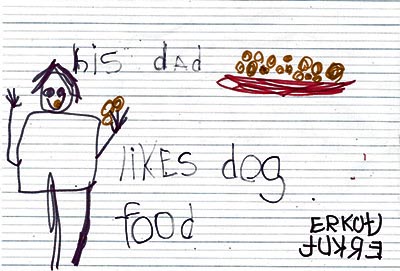
Educators should continually scaffold children's mark making, scribbling, cartoon and emergent writing, to help them to extend upon previous experiences. An obvious starting point is to scaffold children's attempts to write their name.
Through the post-obit ideas for writing experiences, educators tin can support children to write their proper name in authentic ways:
- children "signing in" when arriving at the room
- can begin with placing an detail on their name/face to prove they are here
- so perhaps making a mark next to their proper name/face
- can progress to copying their name
- eventually kid writing their name independently
- children writing (or pretending to write) their name during sociodramatic play experiences
- children adding their proper noun (or a marker to signify their proper noun) on their drawings and other artwork.
- utilize images, sounds, sensory materials, and previous experiences as as a stimulus to help children express their ideas in texts
- for example, you might ask children to draw virtually a contempo consequence or experience
- alternate between modelled/shared/interactive writing behaviours to scaffold children's expression using multiple media
- educators might demonstrate some marks, or shapes they could make using a crayon or a texta; so wait for children to respond with their own marks or shapes; educators could then build upon what the kid has written and scaffold the child to express themselves further, with more elaborate marking making, scribbling, or drawing
- offer opportunities to annotate their work if they would like, using their ain oral narration.
- consider the fine motor requirements of whatever writing implement or material y'all provide children
- take time to model and scaffold children's utilize of implements to create more complex and varied marks, scribbles, drawings, and shape/letter forms, developing their fine motor skills
- support children to utilise writing implements for all kinds of writing experiences from mark making through to using impress to annotate children's own visual texts.
- before children tin can write their proper name, encourage them to make marks to represent their proper name
- model and "call up aloud" the strategies and impress concepts to create texts with children (e.g. spacing between words, tracking left to correct, upper and lower example letters, punctuation marks)
- provide opportunities for children to practice letter germination in functional means (eastward.g. signing in, calculation name to work).
- if children are interested in adding impress to their drawings/writings, provide rhyming words which would permit children to write a few words with similar phonological patterns (east.k. -ap words like: map, gap, sap, lap).
- during functional uses of impress in children'southward writing experiences (east.grand. adding labels, signs etc.) model how simple audio-letter (phonics) patterns can be used to spell short words
- model sounding out and writing a letter (or letter pattern) for each sound in the word
- show children how to say the sounds of their proper noun as they learn to write information technology. For example, Max is spelled: 1000, a, ten. Isla is spelled: I, s, l, a.
- personal (expressive) texts
- imaginative (narratives) texts
- informative (expository) texts.
- procedures for creating a construction, or post-obit a recipe recounts from an excursion or other experience
- cheers letters for family, friends, or guests to the early on childhood setting
- descriptions of favourite places
- creating labels for parts of the room or outside
- creating a sign.
- Victorian Early Years Learning and Development Framework
- VEYLDF Illustrative maps
- use their home language to construct meaning
- develop strong foundations in both the culture and linguistic communication/south of their family and the broader customs without compromising their cultural identities.
- brainstorm to understand and evaluate ways in which texts construct identities and create stereotypes.
- answer through movement to traditional and contemporary music, trip the light fantastic and storytelling of their own and others' cultures.
- listen and respond to sounds and patterns in speech, stories and rhymes in context
- begin to understand fundamental literacy and numeracy concepts and processes, such equally the sounds of linguistic communication, alphabetic character–sound relationships, concepts of print and the ways that texts are structured
- explore texts from a range of unlike perspectives and begin to analyse the meanings
- actively use, engage with and share the enjoyment of linguistic communication and texts in a range of ways
- recognise and engage with written and oral culturally synthetic texts.
- use the creative arts, such as drawing, painting, sculpture, drama, dance, movement, music and story-telling, to express ideas and make pregnant.
- experiment with ways of expressing ideas and meaning using a range of media
- begin to use images and approximations of letters and words to convey meaning.
- brainstorm to brand connections betwixt, and see patterns in, their feelings, ideas, words and deportment, and those of others
- develop an understanding that symbols are a powerful ways of communication and that ideas, thoughts and concepts can be represented through them
- begin to be aware of the relationships between oral, written and visual representations
- begin to recognise patterns and relationships and the connections between them
- depict on retentiveness of a sequence to consummate a chore
- draw on their experiences in constructing meaning using symbols mind and respond to sounds and patterns in speech, stories and rhyme.
- use information and communication technologies to access images and information, explore diverse perspectives and brand sense of their earth
- employ information and communications technologies as tools for designing, drawing, editing, reflecting and composing
- engage with engineering for fun and to make meaning.
- Drawing every bit writing
- Phonological sensation through rhyme and stories
- Stories to tell
- Build and write
- Clay letters: fine motor and phonics
- Leaf colours: playing with language
- Making comics: creating visual narratives
- Megawombat drawing telling
- Posting with friends
- The sounds in my proper name
- Watching sprouts grow
- Exploring and creating texts
- Fine arts – emergent literacy
- Making meaning and expressing ideas in texts
- Advice for Victorian cursive
- Handwriting guide in the primary toolkit
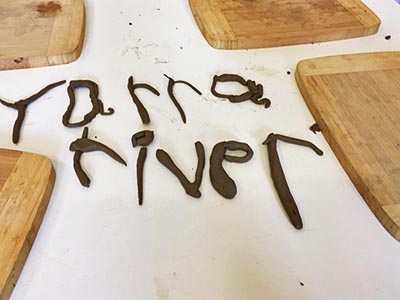
Encounter the resources on handwriting available at the end of this page.
By introducing letter forms, and scaffolding children's writing or cosmos of these letters, educators can demonstrate how to add elements of written language to their drawings, but only if children are prepare and interested to do and so (so as not to lessen the importance of their visual expression in and of itself).
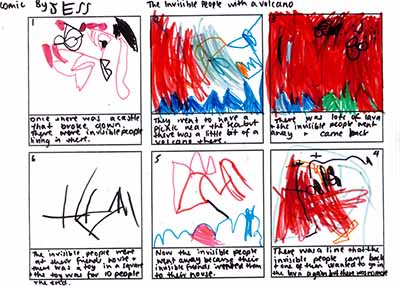
Educators can purposively introduce multimodal text types (like comics, cartoons, posters) that include both a visual and written element, and scaffold children's expression within these kinds of text structures.
After children accept produced their visual contribution, they can work with the educator to annotate the work with the written component(s).
Embedding specific learning foci in writing experiences
Writing with children provides numerous opportunities to develop children's emergent literacy capacities including making meaning/expressing ideas in texts, fine motor skills, concepts of print, phonological awareness, phonics, and creating and exploring texts.
Some ways of facilitating emergent literacy learning foci are below:
Making pregnant and expressing ideas in texts
Fine motor
See Fine motor.
Concepts of print
Phonological awareness
Phonics
Exploring and creating texts
Through writing experiences, children learn how different text types (genres) are structured, and what features they have. Different text types include:
Children can create functional and meaningful texts using mainly drawings/images, only may include some elements of print (with educator support). Functional and meaningful texts can include:
Theory to practice
Bruner'south concept of "scaffolding" was influential in creating the "gradual release of responsibility model" (Duke & Pearson, 2002; Fisher & Frey, 2013; Pearson & Gallagher, 1983) where the responsibility of educational activity varies from solely the educator'south (modelled writing), to sharing more responsibility with children (shared/interacting writing), until children can create texts with very petty support (contained writing).
Using these unlike writing practices, educators tin can dynamically model, scaffold, and back up children to engage in increasingly more complex writing experiences.
The importance of children'south drawing as emergent written expression is important to remember in this teaching practise. Cartoon upon the theories of Dewey and Vygotsky, Richards (2017) argues that children are:
…active participants in their own and other's lives as they make meanings from the world around them and contribute meanings to their worlds … Their participation, which involves co-constructions with people, objects, events and places, results in their competent use and construction of multiple literacies …
Drawing and other art forms accept long provided children with a ways of expressing thoughts and feelings and making sense of feel. Artistic actions and outcomes bridge internal thoughts and external communication – in effect acting as mediating devices, through which children brand meaning, develop higher levels of thinking and generate complex interpersonal relationships."- Richards (2017, p. 128)
Mackenzie'south (2011, 2014) research aligns with this view, demonstrating how drawing is an platonic scaffold and outlet for facilitating rich appointment and construction of texts.
Cartoon (every bit another grade of communication) tin can provide an effective, and important connection betwixt the kinds of expression that children use in early childhood settings (meaning making using multiple media), and those expected in the early years of school (emergence of formal writing).
Mackenzie (2011, p. 324) asserts that:
For many children drawing is both child'due south play (Norris, et al., 1998) and a substantive mental activeness (Sheridan, 2002); a socially meaningful activity and a effective process of thinking in action (Cox, 2005) which allows access to real and imaginary worlds (DuCharme, 1991).
Drawing is 'spontaneous, artful, expressional, and graphic' (Neu & Berglund, 1991) and holds the potential for rich expression and complex learning (Oken Wright, 1998).
Other researchers annotation the benefits of drawing every bit a form of expression that is hands attainable to children, and can assistance them to articulate their ideas holistically:
1 of the great strengths of drawing lies in its ability to immediately reflect dorsum to the person drawing the ideas that are revealed. This is perhaps why young children notice drawing such an bonny and powerful tool. Information technology is immediately holistic and interactive in ways that writing is non.- Brooks (2017, p. 42)
Evidence base
In a study of children in their offset twelvemonth of school Mackenzie and Veresov (2013) constitute that continually encouraging children to use cartoon as the primary form of written expression eased the transition from drawing to conventional writing.
They plant the children's own desire to go on drawing was supported past their connected access to the meaning making tools (i.e. drawing and writing) they needed, in order to express themselves and "construct meaningful texts".
They also constitute that over the grade of the multiple cartoon experiences, children began to gradually supplement their visual text construction with conventional tools of writing (i.east. printed messages and words).
Other enquiry focussing on fine motor, and emergent writing development, has found that children's interest in writing can exist fostered from an early historic period, when provided admission to writing implements:
Our results point that children begin writing from a very young age. Interest in writing can be facilitated past providing children equally young as 3-years-old with the necessary tools (pencils, crayons) and the opportunity to appoint in writing activities.- Puranik and Lonigan (2011, p. 585)
A meta-assay of emergent writing instruction in preschool settings constitute that children'southward emergent literacy development is strongly supported when educators provide guidance or scaffolding and embed emergent literacy concepts in the context of authentic writing experiences (Hall, et al., 2015).
Emerging research is showing the potential benefits of incorporating ICT texts (including electronic books and interactive media), particularly when combined with scaffolding and mediation by adults (Piasta, 2016).
Links to VEYLDF
Outcome ane: identity
Children develop knowledgeable and confident self-identities
Effect 2: community
Children become aware of fairness
Consequence 3: wellbeing
Children take increasing responsibility for their own health and physical wellbeing
Outcome 5: communication
Children appoint with a range of texts and go meaning from these texts
Children express ideas and make meaning using a range of media
Children begin to sympathise how symbols and design systems piece of work
Children use data and communication technologies to admission data, investigate ideas and represent their thinking
Feel plans and videos
For age groups: early on language users (12 - 36 months)
For age groups: early language users (12 - 36 months); language and emergent literacy learners (30 - 60 months).
For age groups: linguistic communication and emergent literacy learners (30 - threescore months).
Links to learning foci and teaching practices:
Handwriting resources
References
Brooks, M. 50. (2017) 'Cartoon to learning' In M. J. Narey, (Ed.) Multimodal perspectives of language, literacy, and learning in early on childhood: The creative and disquisitional "fine art" of making pregnant (Vol. 12). Springer.
Bruner, J. (1990) Acts of pregnant. Cambridge: MA: Harvard University Printing.
Knuckles, Due north.Thousand. & Pearson, P.D. (2002). Constructive reading practices for developing comprehension (Affiliate 10), In A.E. Farstrup & S.J.
Fellowes, J., & Oakley, Grand. (2014). Language, literacy and early childhood teaching, 2nd Edition. Melbourne, Australia: Oxford University Press.
Fisher, D., & Frey, Northward. (2013). Better learning through structured pedagogy: A framework for the gradual release of responsibility.2nd Edition. Alexandria, VA: ASCD.
Hall, A. H., Simpson, A., Guo, Y., & Wang, S. (2015). Examining the effects of preschool writing instruction on emergent literacy skills: A systematic review of the literature. Literacy Research and Educational activity, 54(2), 115–134.
Mackenzie, North. (2011). From drawing to writing: What happens when you shift pedagogy priorities in the first six months of schoolhouse?. The Australian Journal of Linguistic communication and Literacy, 34(3), 322-240.
Mackenzie, N. (2014). 'Transitions to school and emergent writers' In B. Perry, S. Dockett, & A.Petriwskyj (Eds), Transitions to schoolhouse — International enquiry, policy and practice (pp. 89-102). Springer, Dordrecht.
Mackenzie, N., & Hemmings, B. (2014). Predictors of success with writing in the first year of school. Issues in Educational Research, 24(one), 41–54.
Pearson, P. D., & Gallagher, Yard. C. (1983) The educational activity of reading comprehension, Contemporary Educational Psychology, 8, 317-344.
Piasta, S. B. (2016). Current understandings of what works to support the development of emergent literacy in early childhood classrooms. Child Development Perspectives, 10(iv), 234–239.
Puranik, C. S., & Lonigan, C. J. (2011). From scribbles to scrabble: Preschool children'due south developing noesis of written language. Reading and Writing, 24(5), 567–589.
Richards, R. (2017). 'Young children'due south drawings and storytelling: multimodal transformations that help to mediate complex sociocultural worlds' In M. J. Narey, (Ed.) Multimodal perspectives of language, literacy, and learning in early childhood: The artistic and critical "art" of making pregnant (Vol. 12) (pp. 127-147) Springer.
Samuels (Eds.), What inquiry has to say about reading instruction.3rdEdition(pp. 205-242), Newark, DE: International Reading Association.
Saracho, O. N. (2017). Parents' shared storybook reading–learning to read. Early Kid Development and Intendance, 187(3–4), 554–567.
Sunday, K. E. (2017). Drawing as a relational event: Making meaning through talk, collaboration, and prototype production. In M. J. Narey (Ed.), Multimodal perspectives of linguistic communication, literacy, and learning in early babyhood(pp. 87-105). Springer, Cham.
Victorian State Government Section of Education and Training (2016) Victorian Early Years Learning and Development Framework (VEYLDF) Retrieved 3 March 2018,
Victorian Curriculum and Cess Authority (2016) Illustrative Maps from the VEYLDF to the Victorian Curriculum F–10.Retrieved 3 March 2018.Vygotsky, L. S. (1997).
The collected works of Fifty. S. Vygotsky. (R. Due west. Rieber & A. S. Carton, Trans.). New York: Plenum Press, Vol. iv.
Source: https://www.education.vic.gov.au/childhood/professionals/learning/ecliteracy/emergentliteracy/Pages/writingwithchildren.aspx
0 Response to "An Appropriate Form of Primary Grade Childrens Exploration of Art Media Is"
Post a Comment